Debtless
The direct answer: the score change depends on your credit file
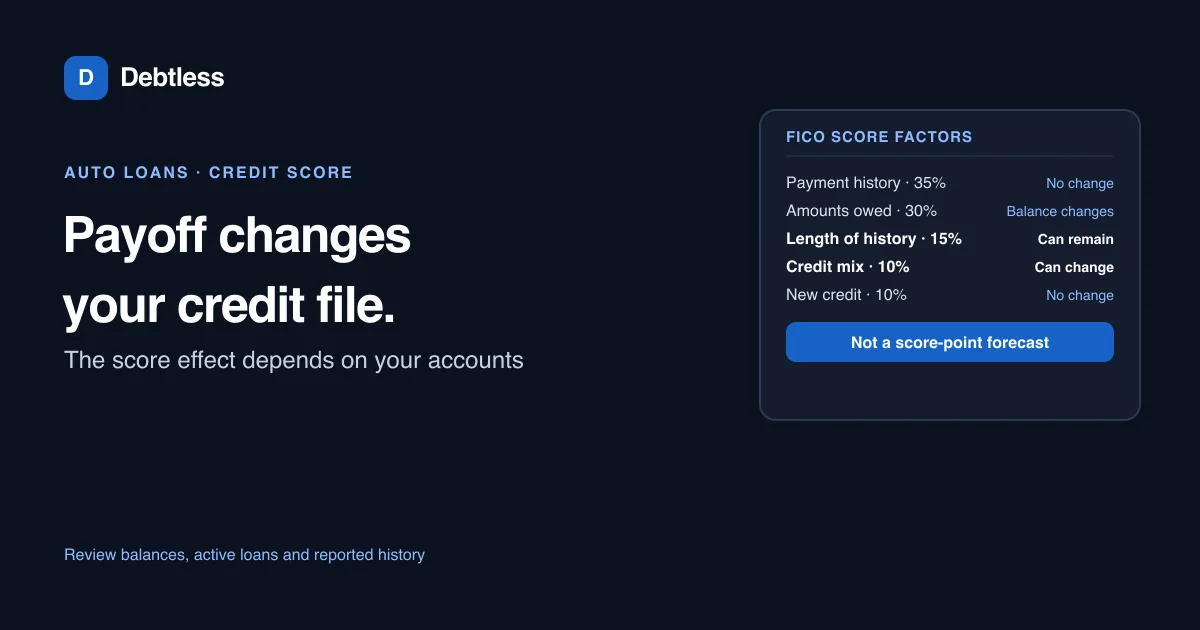
A FICO Score is built from five general categories: payment history at 35%, amounts owed at 30%, length of credit history at 15%, credit mix at 10%, and new credit at 10%, according to myFICO. Those weights do not tell you how many points a particular payoff will change. FICO explains that installment balances are assessed relative to the original loan amounts. Paying off the last active installment loan can reduce a score even though the debt is gone.
FICO also says that paying off the most paid-down installment loan can lower a score while other installment loans remain active. This is not explained only by the age of your oldest account or by having a single installment loan. It depends on the credit file and scoring version.
What actually changes on your report
Once the loan is paid off, the account status changes from an open installment loan to a closed one with a $0 balance. It stops adding new monthly payment history going forward, but according to Experian, a closed account in good standing doesn't disappear from your report right away and keeps contributing to your credit history for years after it's closed.
Paying off your only active installment loan changes the active-account mix, but it does not automatically erase the account's age or history. FICO explains that reported closed accounts remain eligible for credit-history measures until they are no longer reported. Do not take on a new loan solely to change your credit mix.
Why this is different from paying off a credit card
Paying down a credit card usually helps a score, because it lowers your credit utilization, the share of your available revolving credit you're using, which sits inside the 30% amounts-owed category. Credit utilization and paying down cards explains that calculation. An installment loan like a car loan doesn't work the same way; FICO treats the remaining balance on a fixed-term loan differently than a revolving balance, so paying it off early doesn't produce the same utilization boost, and can instead change installment balance-to-original-amount measures and the mix of active accounts.
If the card account has been charged off, check what a charged-off credit card means for the debt and your payoff plan before treating it like an open revolving account.
That distinction is why the same action, paying off debt early, can nudge a score in opposite directions depending on which kind of account you're closing.
Should you still pay it off early?
Compare the interest and any prepayment charge with your cash needs, other debts, and plans to apply for credit. A score change is not a fixed number of points and has no guaranteed recovery date. Amortization: why early loan payments are mostly interest explains how the interest portion of a standard amortizing loan changes over its term.
If the car loan is one of several debts competing for the same monthly budget, it's worth sizing it up against the others before deciding what to pay off first. How long does it take to pay off $10,000 in debt? is a useful comparison point for a similar-sized balance, and if you're working with a smaller amount on a tighter timeline, How to pay off $5,000 in one year lays out what that pace actually requires.
FICO factors touched by an early auto loan payoff
| FICO factor | Weight | Affected by paying off a car loan early? |
|---|---|---|
| Payment history | 35% | No, your on-time record stays on your report |
| Amounts owed | 30% | The balance becomes $0; the scoring effect is not always positive |
| Length of credit history | 15% | A reported closed account can still contribute to age-related measures |
| Credit mix | 10% | Closing an active installment loan can change the mix of active credit |
| New credit | 10% | No, paying off a loan isn't a new inquiry |
FICO Score factor weights per myFICO's breakdown of what's in a FICO Score. The actual point impact of any single account change varies by credit profile and isn't published by FICO.
Worked example · illustrative numbers
Example: what's actually at stake on a $8,000 balance
Take a hypothetical auto loan with $8,000 remaining, 12 months left, and an assumed 6.35% annual interest rate. With monthly amortization and no added fees, the monthly payment is about $689.82 and the remaining interest is about $277.83. Payment rounding and the lender's payoff calculation can differ.
Paying that balance early could avoid some remaining interest, but check the actual payoff quote and any prepayment charge. Compare that cost with your cash needs and other debts. The example calculates interest; it does not predict a score change or tell you which debt to pay first.
Put this into practice with Debtless
Debtless tracks an auto loan the same way it tracks every other debt, by balance, rate and term, so once you pay it off you can immediately see how much of your monthly budget just freed up to put toward what's left in the free iPhone app.

Common questions
Does paying off a car loan early help or hurt credit?
It can lower a score when the payoff changes installment balances or active-account mix, but it can also leave the score similar or higher depending on the rest of the credit file. A reported closed account can still contribute to credit history. Unlike paying down revolving balances to lower credit utilization, an auto-loan payoff does not create the same utilization benefit. Before paying early, also check how extra payments on an auto loan are applied and whether your contract has a prepayment charge.
How long does the dip last?
There is no fixed point change or recovery timeline that applies to every credit file. The result depends on the scoring version and the balances, history, and other accounts reported at the time.
Does this apply to paying off a mortgage or student loan early too?
Installment balance and active-account changes can matter for mortgages and student loans too. FICO distinguishes mortgage and non-mortgage installment balances; do not assume that every loan type or scoring version produces the same effect.
Should I avoid paying off my car loan early to protect my score?
Do not assume that paying early will cause a particular score change. Compare the actual interest and any prepayment charge with cash needs, other debts, and plans to apply for credit. Borrowing solely to alter your credit mix is not a substitute for that comparison.
Sources & further reading
- myFICO: What's in your FICO Score
- Experian: Will paying off a loan early help my credit?
- myFICO: Paying off installment loans and FICO Scores
- myFICO: Why a score may drop after a loan payoff
- myFICO: Reported closed accounts and credit history
General education for U.S. readers, not individualized financial, legal or tax advice. Examples are hypothetical; lender terms and actual interest calculations can differ. Check your current statements and agreements.
Published by Debtless with AI-assisted drafting. How this journal is made · Suggest a correction