Debtless
The short answer
Use three steps to negotiate with a debt collector: confirm the debt, amount, and current owner; calculate a lump sum or payment plan you can actually afford while keeping an emergency margin; then make a proposal and obtain every promise in writing before paying.
Should you negotiate or ask for validation first?
A debt collector must give you certain validation information about the debt in the initial communication or generally within five days, including the amount and creditor details. Negotiating before you confirm that information means discussing a number that may be inaccurate or may not be yours; A debt collector called: what to do first covers the moves to make in that first conversation.
Once the account, the balance and the creditor check out, validation is done and negotiating a lower payoff is a separate move entirely. How to ask a collector to validate a debt walks through that request on its own, since mixing the two steps together is the most common way people weaken their own negotiating position before they've even made an offer.
Set a ceiling you can actually afford
There is no universal settlement percentage and no collector has to accept a proposal. Build your ceiling from money that remains after required bills, minimum debt payments, and an emergency margin. If the only workable option is a short payment plan, choose exact dates and amounts you can sustain instead of promising a larger lump sum you do not have.
Before discussing a number, check state-specific time limits and understand whether a payment or acknowledgment could affect your legal position. If the debt is old, disputed, or tied to a lawsuit, consider qualified legal help before acting.
How do you make the actual offer?
Call with the verified account details in hand, explain whether you are proposing a lump sum or a short payment plan, and name a specific amount within the ceiling you already calculated. Ask how the account will be treated after completion and do not let a counteroffer push you beyond money you can safely commit.
- Confirm the balance and account number out loud before naming any dollar figure.
- Offer a specific affordable amount or payment schedule rather than relying on a supposed typical percentage.
- If they counter, compare the new amount with your ceiling and emergency margin before responding.
- Ask them to send the agreed terms in writing before you schedule or send a payment.
What should you get in writing before you pay?
The CFPB is direct about this one: get the plan and the collector's promises in writing before you make a payment, including the exact settlement amount, how the account will be treated after completion, when collection activity stops, each payment date, and the date the offer expires. A verbal agreement gives you little evidence if the account is later handled differently.
This page focuses on verifying the account, setting an affordable ceiling, and making the proposal. Read how to negotiate a settlement with a collector for the written-agreement and tax follow-through after a collector accepts.
A creditor may report canceled debt on Form 1099-C when reporting rules apply, but the reporting threshold does not by itself determine whether the canceled amount is taxable income. Tax treatment depends on the facts and possible exclusions, so keep the agreement and any tax form and consult a qualified tax professional when needed.
Before you make a settlement proposal
| Check | What to confirm | Why it matters |
|---|---|---|
| Debt, owner, and amount | The account is yours, the balance is supported, and the collector currently owns or services it | You should not negotiate an unverified obligation |
| State-specific time limits | Whether the debt's age or a payment could affect your legal position | Old debts can require legal context before action |
| Affordable ceiling and emergency margin | The most you can pay without missing essentials or emptying your buffer | A settlement should not create a new emergency |
| Exact payment dates | Each due date and amount for a payment plan | The schedule must fit real cash flow |
| Account treatment after completion | How the collector will describe the completed account | The written result should match the promise |
| Written confirmation before payment | The full agreement and every promise in writing | Do not rely on a phone conversation alone |
Use your verified records, state law, and actual cash flow. There is no safe universal settlement percentage.
Worked example · illustrative numbers
Example: setting a ceiling on a $2,400 balance
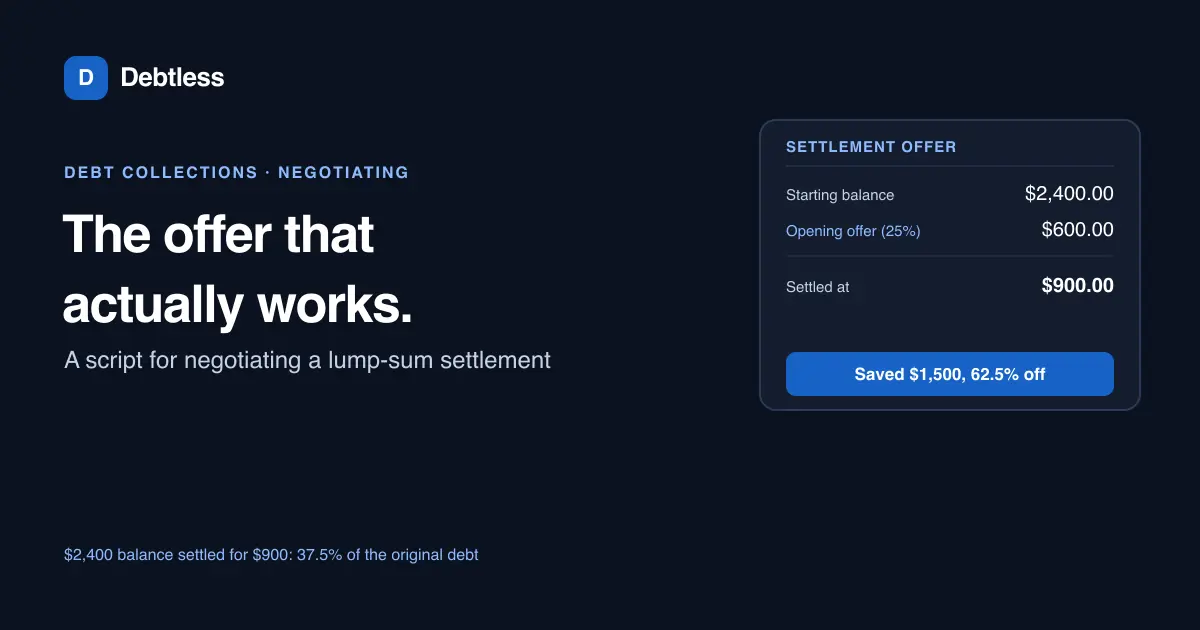
Take a hypothetical verified $2,400 credit card debt with a collection agency. After required bills, minimum payments, and a separate emergency margin, the reader can commit no more than $900. That $900 is a personal affordability ceiling, not a typical settlement percentage or a prediction of what the collector will accept.
The reader proposes $750 and receives a $1,200 counteroffer. Because $1,200 exceeds the ceiling, the next step is to restate the $900 limit or pause, not to promise money that is unavailable. If the collector accepts $900, the reader asks for the exact amount, deadline, account treatment, and other promises in writing before paying.
Put this into practice with Debtless
Once a settlement is signed, Debtless lets you update that account's balance to the new amount and see exactly how clearing it changes your overall debt-free date next to every other balance you're tracking, right inside the free iPhone app's payoff calculator.

Common questions
Can I negotiate with a collector before validating the debt?
You can, but it's risky. Confirming the balance, account and creditor first means you're negotiating a number you know is accurate, instead of settling an amount that might be wrong or already past the point a collector could legally sue over.
Will a debt collector really put a settlement in writing?
A legitimate one will, and the CFPB recommends treating any that won't as a reason to not send payment. The written agreement should state the exact amount, that it settles the account in full, and that collection activity stops.
Do I owe taxes on debt that gets forgiven through a settlement?
Canceled debt can be taxable, but receiving a Form 1099-C or crossing its reporting threshold does not by itself decide the tax result. Keep the form and settlement records, review possible exclusions, and get qualified tax help for your circumstances.
What's a reasonable opening offer to a debt collector?
There is no universal reasonable percentage. Start with a specific amount or short payment plan below the ceiling your cash flow supports, leaving room for required bills and an emergency margin, and do not agree above that ceiling.
Sources & further reading
- CFPB: How do I negotiate a settlement with a debt collector?
- Experian: How to Negotiate With Debt Collectors
- CBS News: What is the success rate of debt settlement?
- IRS: Instructions for Forms 1099-A and 1099-C
- IRS: Topic No. 432, Form 1099-C, Cancellation of Debt
General education for U.S. readers, not individualized financial, legal or tax advice. Examples are hypothetical; lender terms and actual interest calculations can differ. Check your current statements and agreements.
Published by Debtless with AI-assisted drafting. How this journal is made · Suggest a correction